Adventures in Loxone: 2 - Basics of White Lighting
Before we can get into advanced lighting, especially with full RGB and more, we need to start somewhere. And that somewhere is white lighting - color temperature, configuration, and more.
10/29/20247 min read
Measuring Light - White
Light is a complex topic, and I'll be using some approximations, hand-waving, and such, throughout this article. If someone/anyone really wants me to talk about CIELa*b* color space, XYZ color space, illuminants, and more, I can - but let's be honest - most people really shouldn't want me to talk about that. (But for those that still do? Let's have some serious fun!)
So we'll start with 'white'. There are several 'shades' of white, and we generally talk about them by the temperature of the thing that would emit that light if it were heated. Thus, we talk about "2700 Kelvin" white vs "6000 Kelvin" white, and such.
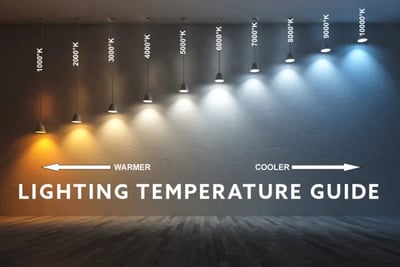
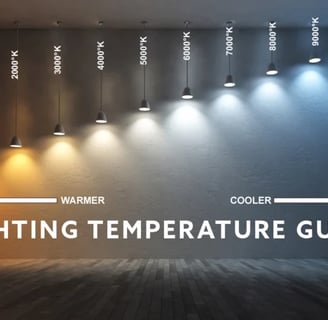
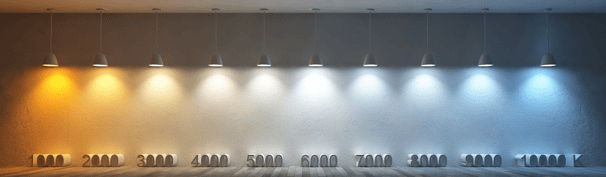
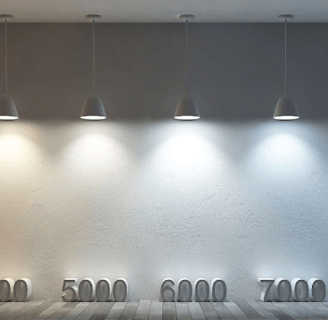
The figures/images above show how a lower temperature means a 'redder' shade, while a higher temperature means a 'bluer' shade - but they're all 'white' technically. Loxone products tend to be 3000K by default, which is a common 'slightly warm' shade often used in residential settings. Shades in the 4000K to 6000K are more 'daylight', and also more commonly used in commercial settings like hospitals. Sub 2000K is sometimes nice as a 'candle' or 'fire' shade.
Measuring Light - Intensity
If the color temperature tells us how 'warm' or how 'cool' a given white is, the next question is how bright it is. Light bulbs tend to be measured in Lumens. Loxone spots are (in my opinion) fairly dim, emitting only 525 lumens per bulb (see page 2). Philips Hue, on the other hand, has RGBW bulbs that range from 806 Lumens to 1521 Lumens. Thus, if we want to make a room a 'certain amount' of bright, we'll simply need more Loxone bulbs than we will Philips Hue bulbs. This is one of the things I'd love to see Loxone improve upon - making kitchens and bathrooms bright enough requires making a ceiling look like Swiss cheese (in my opinion), and brighter bulbs would help.
Measuring Light - Brightness
If a given bulb emits 525 Lumens, how many bulbs do we need? This comes down to one of two measurements - Lux, or Foot-Candles. Imperial measurements are so 'last millenium', and I prefer metric (Lux) but I'll explain both, as American rooms tend to be measured in square feet.
A Lux is one Lumen per square meter. So if I have a room that's 8 square meters (86 square feet), with only one Loxone spot in it (525 Lumens) then it has 65 Lumens per square meter, or 65 Lux. In a much bigger room, say, 28 square meters (301 square feet), those same 525 Lumens would be spread out much further, and the resulting room would be much dimmer - only 18.75 Lux. In general, it's just (Total Lumens) / (Square Meters of the Room).
Foot-Candles are similar, but with imperial units. It's one Lumen per square foot, so much simpler for Americans. In the rooms above, the small room (525 Lumens, spread across an 86 square foot room) would be 6.1 foot-candles, while the larger room (525 Lumens across 301 square feet) would be only 1.74 foot-candles. Again, the equation is very simple - just add up the Lumens of all the lights in the room, and divide by the square feet of the room.
But how bright do we need/want? I've got two ways to explain it. One is to point to actual standards bodies, such as the IES, which has recommended lighting levels. The dimmest thing they recommend is 30 Lux (3 foot-candles), for things like living rooms and hallways, while bright areas like kitchens and bathrooms are recommended to be 300 Lux (30 foot-candles).
Personally - I think that method of analyzing brightness is a bit insane, and hard to follow and trust. So here's how I actually recommend figuring it out.
Wait until night time, and pick/find a room in your house that has 'sufficient lighting'. Add up how many Lumens of bulbs make it that way, and divide by the size of the room. Do that a few times, and you'll rapidly get a feel for how many Lux or Foot-Candles you find 'pleasing' and 'appropriate'. As an example, my living room is 15x18, so 270 square feet. It's got 6 bulbs, each 665 Lumens in it, for 3,990 Lumens total. This means 14.7 foot-candles. Now, it's a little dim for my tastes. Thus, in general, for most 'normal' rooms, I personally target 20 foot-candles (~215 Lux), and for areas like kitchens and bathrooms, I shoot for double that. When in doubt, if budget allows, I add more light. I can always dim down to 80%, but can't overdrive to 120%.
Counting Bulbs - Case Studies
So let's consider a few rooms to work through this all.
A large kitchen, 300 square feet in size
A living room, 280 square feet in size
A large storage room, 100 square feet in size
The kitchen will want to be bright. Let's suppose we target 300 Lux (27.8 foot-candles) That means we'll need 300 sqft * 27.8 fc = 8,340 Lumens of light. We can get that with 15.8 Loxone RGBW Tree Spots. Since buying "0.8" lights is hard, we can either use 15 or 16. Since we can always dim down a few percent, but can't 'overdrive' a light, I'd suggest 16 spots for a room of this size. But we might also get away with 15 easily, depending on the layout of the kitchen.
The living room doesn't need to be so bright. We might only target 15 foot-candles (161 Lux) there, so we'd need 280 sqft * 15 fc = 4200 Lumens. That means 8 Loxone Tree Spots.
Finally, the storage room can likely be fairly dim - maybe only 10 foot-candles. That would mean 100 sqft * 10 fc = 1000 Lumens, or 1.9 Tree Spots. Again, I like to round up where I can, as I can always run the light at 80%, but not at 120%.
On average, then, let's say that a whole house might want an average of 23 foot-candles, and might be 3000 square feet. As a first order ballpark, that means the house needs 69,000 Lumens, or ONE HUNDRED AND THIRTY ONE tree spots for the whole house. At $120 each, that's nearly $16,000 of spots. Before labor, wire, etc. You'd obviously want to do a more detailed analysis as you work with your clients, but that gives us a rough idea of just how expensive it can be to do Loxone lighting for a whole house - especially if using only the RGBW tree spots.
Counting Bulbs - An Equation
Interestingly enough, Loxone has a 'calculator' on their site to estimate how many spots a given room needs.
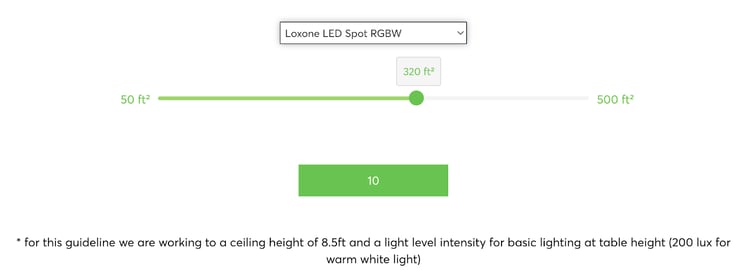
In the screenshot above, we see a few things. For a 320 square foot room, it recommends 10 spots, providing 5250 Lumens. That means 16 foot-candles, or about 172 Lux. The tool also asserts that it tries to hit a target of 200 Lux, so things track. I'm not sure of the details of how Loxone does this tool, but clearly it's very similar.
Value Engineering Lighting with PWM Warm White
I really hate spending so much money on lights, and having such a Swiss cheese ceiling. I really wish Loxone would do 800 Lumens/bulb at the current price and power consumption. I especially wish they could do it with a "Tunable Dynamic White" bulb that can do between 2700K and 5000K very well. But since that hasn't happened yet, let's talk about other ways to value engineer lighting for your customers.
The first, most obvious solution, is to consider using the "PWM WW" series of lights. These are only half the price of the more advanced RGBW Tree lights, but they require a Loxone Dimmer to drive them. Since the dimmer is ~$120, doing this for a single light is a terrible idea. You spend more on the dimmer and the 'cheap' light than you do on the more expensive light. However, for bigger rooms, where you might have (for example) a dozen lights, you'd either need a dozen RGBW lights ($1440) or a dozen cheaper lights ($720) plus a dimmer ($120) for a total of $840 - and more pointedly, savings of nearly $600. At the same time, you also need to wire them all on a dedicated line, and also consider how complex that wiring is. At 50W max per channel on the dimmer, each channel can only handle 6 lights. Thus, we'd need to use at least two channels on the dimmer to drive them all. Similarly, that dimmer, drawing 90W, is essentially a whole Class 2 circuit on its own, and effectively has to have a dedicated supply. If you tried to run more than 12 such lights, you're no longer Class 2, and oh gosh I wouldn't want to deal with that. It would suddenly mean that every light needs a junction box, that wiring must be 14AWG NM-B Romex, and more. So a dozen lights is the most cost-effective it'll ever be - it's not like you can put 26 lights on the dimmer (possible at 200W, admittedly, but no way to do it in four channels of 50W each) or even 24 lights. That would mean you'd need to be Chapter 3 wiring, and at that point, it's likely easier to just use a second dimmer, and second Class 2 supply.
Value Engineering Lighting with Tunable White-White LED Strips
Another thing I'm fond of is "Tunable White" LED strips. These have two channels internally, one for warm white, one for cool white, and with Loxone, you can easily control them to vary over the course of the day to match the local sunlight. These strips put out 60 Lumens per Watt, and each channel is 6W per meter. Thus, a single 5 meter strip pulls 30W per channel, putting out 1800 Lumens of the channel's color. If you want to fully mix them, you can squeeze 3600 Lumens out of one strip, but even in single color, each strip ($156) has as much light as 3.4 Loxone Spots. Since each channel is 30W, you can run just under two full strips while still being Class 2, from a single dimmer. This is how I lit my personal kitchen - I used a few Loxone spots over important areas, like the stove, sink, etc - and then have strips mounted in recessed channels in the ceiling for additional light. Now, there is one key thing I ignored - the mounting channels. Well-done/visually appealing LED strips aren't just stapled to the ceiling, they're in nice pretty aluminum channels. And those do make it less value-effective. But it's still something to consider and evaluate as you work with your clients.
Before I end this article, then, I should mention Wired4Signs. They are the only vendor I work with for LED profiles. They have virtually everything, great prices, and the best customer service staff I get to work with. I can't recommend them enough. If you need LED profiles? Go to their site. Find what you need. They're great.
Innovate
Engage
owner@cltsmarthome.com
814-441-1443
© 2025. All rights reserved.
Disclaimer: This site is under construction, and the images are stock, not actual photos of work done by CLT Smarthome Link.